Robotic Welding vs Manual Welding: A Cost Comparison for Small Factories
"Robots are for the big plants" is one of the most expensive assumptions in small-factory manufacturing. The math has changed. Entry-level welding automation is now within reach of shops running 20 to 60 welding hours a week — and the comparison is not as one-sided as most owners believe.
This article runs the numbers in plain terms: labor cost, duty cycle, weld quality, rework, and capital, so you can decide whether a robotic welding cell belongs in your shop.
The cost of a manual welder hour
A skilled welder in North America or Western Europe costs the shop roughly $35–55 per hour all-in (wage, benefits, taxes). That is the rate while they are welding. In practice, a manual welder is physically welding maybe 30–45% of the shift. The rest goes to fit-up, repositioning, cleaning, rest breaks, and rework of spatter and distortion.
That works out to a usable weld hour that is far more expensive than the sticker rate suggests.
What a robotic cell changes
- Duty cycle climbs to 70–90% — the robot does not take breaks or stop to reposition heavy parts.
- Consistency is repeatable — the same program lays the same bead on the 100th part as on the 1st. Rework from human inconsistency mostly disappears.
- One operator can run two cells — loading and unloading while the robot welds. Your labor input per weld meter drops sharply.
The honest caveat: robots need programming, fixtures, and setup. They are not a drop-in replacement for a welder — they are a different production system.
A worked comparison for a 50-weld-hour week
Assume a shop with 50 manual welding hours per week, a loaded labor rate of $45/hour, and a rework rate of 8% (typical for mixed manual work).
Manual baseline (per year, 48 working weeks) - 50 h/week × $45 × 48 = $108,000 labor - Rework: 8% of weld time ≈ $8,640 labor + consumables - Distortion repairs and re-positioning are hidden in the hours above - Total annual welding cost: roughly $117,000
Robotic cell (per year) - Capital: entry cell (robot + positioner + guarding + programming) ≈ $60,000–90,000 - One operator at 25 h/week (tending two cells part-time) ≈ $54,000 labor - Energy and consumables: ≈ $6,000 - Annual operating cost: ≈ $60,000, plus capital amortized over 5 years ≈ $15,000/year - Total first-year cost: ≈ $75,000; steady-state from year two: ≈ $60,000
The crossover is around 25–35 weld hours per week. Below that, manual welding stays cheaper; above it, the robotic cell pays for itself in roughly 2 to 3 years — and then keeps saving $50,000+ a year.
Where robotic welding pays off fastest
- Repeatable joints on similar parts — brackets, frames, and fixtures with geometry that repeats.
- Rotary work — parts that can sit on a positioner so the robot welds in the flat or horizontal position, which is faster and cleaner than vertical or overhead manual welds.
- High-volume small parts where fit-up is controlled and fixtures can be made once and reused.
It pays off slowest when every part is a one-off with uncontrolled gaps — fit-up variation is the robot's biggest enemy.
Plan the cell before you buy the robot
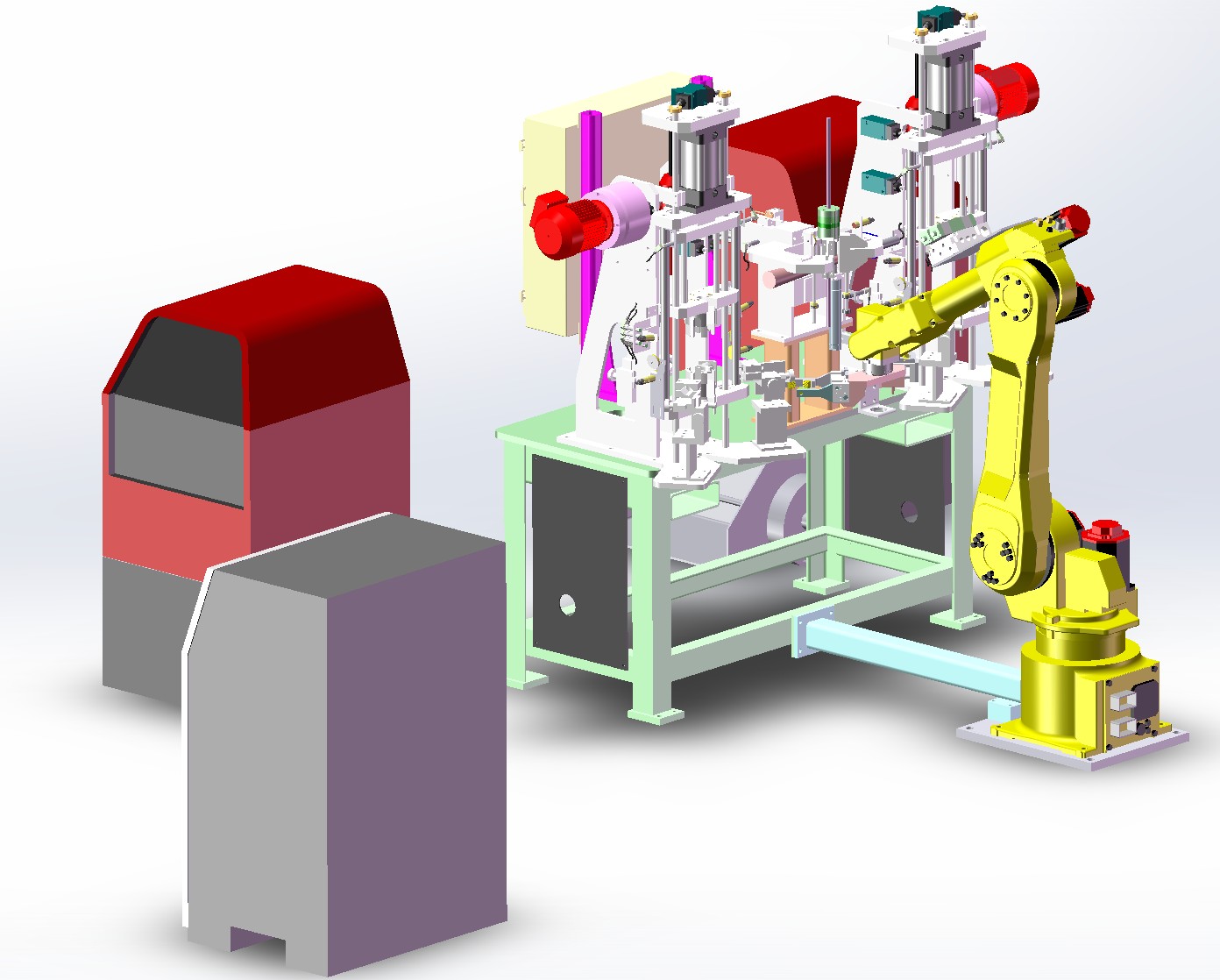
This is where CAD pays for itself. Before committing capital, lay out the cell: robot reach vs. part envelope, positioner swing, guarding clearances, and torch angles. A robotic welding & inspection station model in STEP format lets you verify the layout, cable paths, and operator access in SolidWorks before the equipment order — the same reason integrators model every cell before quoting it.
For rotary work, a welding positioner jig frame model helps you confirm the part can be oriented for flat-position welding and that the fixture clears the guarding. If you need one dimensioned to your part, describe the part and the cycle and we will model it.
The decision checklist
- [ ] Count your real weekly weld hours, not the shift hours
- [ ] Measure rework as a percentage — most shops undercount it
- [ ] Check whether your parts repeat enough to fixture once
- [ ] Model the cell and confirm reach, positioner swing, and guarding before ordering
Bottom line
Robotic welding is not reserved for automotive giants. At 30+ weld hours a week with repeatable parts, a cell pays back in 2–3 years and eliminates the quality lottery that manual welding brings. The risk is not the robot — it is buying it without laying out the cell first. Model it, verify it, then commit.
If you want to evaluate a robotic welding cell layout for your own part mix, start from the Robotic Welding & Inspection Station 3D model (STEP, SLDPRT, SLDASM, $188 indicative) or describe your parts and cycle on the custom design page and get a modeled solution around your constraints.